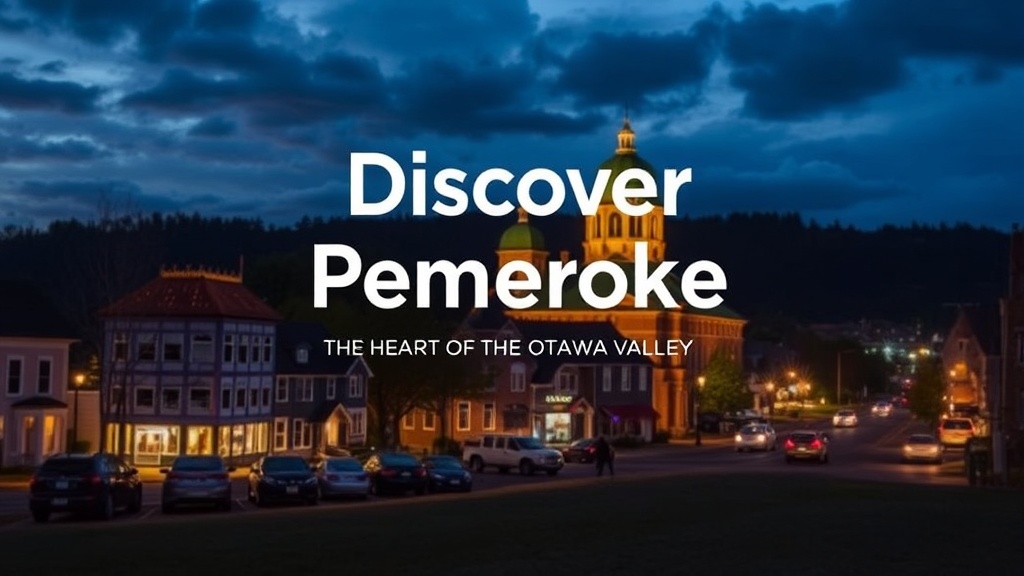
Discover Pembroke: The Heart of the Ottawa Valley

What makes Pembroke the heart of the Ottawa Valley?
Pembroke sits at the confluence of the Muskrat River and the Ottawa River, serving as the geographic and cultural centre of the Upper Ottawa Valley. This post covers the real reasons visitors make the drive from Ottawa (about 150 kilometres northwest) — from world-class outdoor recreation to one of Ontario's most surprising heritage sites. Whether you're planning a weekend escape or researching a potential move, Pembroke offers a distinct blend of small-city convenience and rugged Valley character that's worth understanding before you arrive.
Where is Pembroke and why does the location matter?
Pembroke sits roughly halfway between North Bay and Ottawa along the Trans-Canada Highway corridor, positioned where the Laurentian Highlands start their rise from the Ottawa River valley floor. This geography shapes everything — the economy, the culture, and the recreation.
The city straddles the border between the Ottawa Valley proper and the start of the Canadian Shield. Drive ten minutes north and you're in dense bush and granite outcrops. Head south across the Trans-Canada Highway and you're in rolling farmland that stretches toward the St. Lawrence River lowlands. This transitional zone means Pembroke functions as a hub — a place where loggers, farmers, cottagers, and government workers have mingled for generations.
The Ottawa River dominates the southern edge of town. Not the canal — the actual river, wide and powerful, historically the highway that moved pine and oak from the interior to Montreal and Quebec City. That logging heritage isn't museum-piece nostalgia here. You'll see it in the architecture (the Pembroke Hydro Office on Mackay Street still carries that 1920s utilitarian grandeur), in the local festivals, and in the fact that the Ontario Ministry of Natural Resources and Forestry maintains a significant regional presence downtown.
The climate is classic Canadian continental — humid summers that make the river swimming holes worthwhile, and winters cold enough to freeze the Muskrat solid for months. That said, the Valley location creates interesting microclimates. Spring arrives slightly earlier than in the higher terrain to the north. Fall colour season peaks in late September and early October, drawing photographers and hikers from Ottawa who've learned that the shorter drive to Gatineau Park means fighting crowds.
What is there to do in Pembroke besides outdoor activities?
Pembroke punches above its weight on the culture front — specifically in areas that reflect the region's history and demographics.
The Champlain Trail Museum and Pioneer Village operates on Bowen Boulevard and represents the most significant heritage collection between Ottawa and North Bay. It's not a dusty collection of butter churns (though yes, there are butter churns). The site includes the original 19th-century Hudson's Bay Company factor's house, relocated and restored, plus a working blacksmith shop and a replica 1920s schoolhouse. The depth of logging industry artifacts — from peaveys to massive steam donkey engines — is genuinely impressive. Plan for two hours minimum.
For performing arts, the Festival Hall Centre of the Performing Arts on Irvine Street hosts everything from touring Broadway productions to local theatre and the Pembroke Symphony Orchestra. The building itself — opened in 2013 — represents one of the more ambitious cultural infrastructure investments in Eastern Ontario over the past two decades. Check their schedule; you might catch the Kingston Symphony or a touring production of something that just finished its Toronto run.
The Pembroke Public Library on Victoria Street holds an unexpected draw: one of the best local history archives in the province. Genealogists researching Ottawa Valley families regularly make pilgrimages here. The collection of French-Canadian and Irish settlement records is particularly deep — Pembroke served as a reception point for both groups during the 19th century.
Worth noting: Pembroke maintains an active francophone community despite being outside the designated bilingual belt. You'll hear French spoken routinely in restaurants and shops. The Centre culturel Eugène-Rouleau on Isabella Street anchors this community with programming that includes theatre, music, and visual arts exhibitions. Even if you don't speak French, the gallery space is worth a visit — the curation often surpasses what you'd expect in a city this size.
The local food scene won't compete with Ottawa's ByWard Market, but it has character. The Nook Café on Pembroke Street West does third-wave coffee that would pass muster in Toronto. The Riverside Grill on Paul Martin Drive serves the best fish and chips in the Valley — hand-cut, beer-battered, sourced from local suppliers when possible. For something fancier, The Waterfront Gastropub (recently rebranded from its previous incarnation) focuses on locally sourced ingredients and maintains a respectable craft beer selection including options from Whitewater Brewing Company just down the road in Cobden.
What outdoor activities can you do around Pembroke?
This is where Pembroke earns its keep. The outdoor recreation infrastructure within a 30-minute radius rivals what you'd find near much larger centres.
The Ottawa River Water Trail
The river isn't just scenery — it's usable infrastructure. The Ottawa River Water Trail runs right past Pembroke, offering day-trip and multi-day paddling options. The stretch from Pembroke to Chenaux Islands (downstream) provides calm water suitable for novice kayakers, with several public access points maintained by the city. Upstream, the Whitewater Region (yes, that's the actual municipal name) delivers class II-IV rapids depending on season and water levels.
Several local outfitters rent equipment and provide shuttle services. Owl Rafting — based nearby but operating on multiple river sections — runs guided trips through the legendary Rocher Fendu rapids. The catch? You need to book ahead during peak summer weekends. Demand exceeds supply, especially for the multi-day camping trips.
Trail Systems
The Ottawa Valley Recreational Trail — a converted rail line — runs through Pembroke, offering 296 kilometres of multi-use path stretching from Sudbury to Smiths Falls. The surface varies (gravel in most sections, paved near urban centres), but the Pembroke stretch is well-maintained and suitable for road bikes with reasonable tire clearance.
For mountain bikers, the Topheti Trails network (located just west of town on Crown land) offers technical singletrack through mixed hardwood forest. The trails aren't marked as aggressively as you'd find in Ontario's provincial parks — download the Trailforks app before you go.
Winter Options
When the snow flies, Pembroke transforms. The Pembroke Golf Club — yes, the golf course — maintains 10 kilometres of groomed cross-country ski trails that rival anything in the National Capital Region. Membership isn't required for trail use; day passes run about $15.
Downhill skiers head 40 minutes north to Mount Pakenham (technically in Pakenham, but close enough). It's not Blue Mountain — think family hill with night skiing and a terrain park. The value proposition is strong, especially for learners and intermediate skiers who don't want to pay Tremblant prices.
Snowmobilers know Pembroke as a trail hub. The Ottawa Valley Rail Trail connects to the broader OFSC (Ontario Federation of Snowmobile Clubs) network, providing access to thousands of kilometres of groomed trails. Several gas stations and restaurants in town cater specifically to sled traffic — look for the OFSC trail signs directing you to fuel and food.
What should you know before visiting Pembroke?
The practical details that separate a smooth trip from frustration.
| Category | Pembroke | Comparison |
|---|---|---|
| Population | ~14,000 city / ~24,000 census agglomeration | Similar to Brockville, larger than Perth or Carleton Place |
| Distance from Ottawa | 150 km (90 min drive) | Comparable to Calabogie or Mont Tremblant |
| Hospital | Pembroke Regional Hospital — full service, 24-hour ER | Unlike many small towns, no need to drive to Ottawa for emergency care |
| Accommodation | Limited chain hotels (Comfort Inn, Quality Inn), several B&Bs, AirBnB options growing | Fewer options than Renfrew or Arnprior; book ahead for summer weekends |
| Cell service | Full LTE coverage in town; spotty on river and trails | Download offline maps before heading to remote areas |
Timing matters. The Pembroke Old Time Fiddling and Step Dancing Festival — held annually in September — draws thousands of visitors and books accommodation solid. If you're not coming for the festival, avoid that weekend or stay in nearby Petawawa (Canadian Forces Base Petawawa sits adjacent to Pembroke and provides overflow accommodation options).
Here's the thing about Pembroke's relationship with Petawawa: they're functionally one community separated by a municipal boundary. Most locals work, shop, and socialize across both towns. When researching restaurants or services, search both names. You'll find more options than looking at Pembroke alone.
The downtown core — centered on Pembroke Street between Mary and Mackay — has suffered the same pressures as every Ontario small city. Some vacant storefronts, some surprising survivors. The revitalization efforts are genuine but ongoing. Don't write it off; the businesses that remain tend to be the ones worth supporting.
One practical note: the Ottawa River itself is deceptive. It looks placid from Waterfront Park, but currents run strong, and cold water temperatures persist into June. The public beach at Riverside Park is supervised in summer; swimming elsewhere requires caution and local knowledge.
Pembroke doesn't try to be Ottawa or Toronto. It won't dazzle with nightlife or Michelin-adjacent dining. What it offers is something increasingly rare — a functioning small city with real history, immediate access to serious outdoor recreation, and a community that hasn't been entirely hollowed out by chain retail and remote work exodus. The heart of the Ottawa Valley isn't a marketing slogan here. It's a description of where things connect — rivers, trails, highways, and people who've chosen to stay in a place that lets them fish before work and ski after.